Blog

  • The First Point: Conscious Movement

    The First Point: Conscious Movement

    Chapter 4 of Realized Serenity

    The First Point: Conscious Movement

    The First Point: Conscious Movement

    The journey to inner stillness begins with the body. Conscious Movement is a moving meditation where the quality of your attention is more important than the intensity of your effort. A steady body helps create a steady mind, preparing a comfortable container for a quiet and serene inner world.

    Excerpt

    The journey to inner stillness begins with the body. In our modern lives, we often treat our bodies as vehicles to carry our minds from one task to the next. We live in our heads, disconnected from the physical sensations and wisdom of the body. The first point of our foundational practice is to heal this disconnect through Conscious Movement.

    This is not exercise in the conventional sense. The goal is not to burn calories or build muscle, though those may be pleasant side effects. The primary purpose of Conscious Movement is to unite the mind and body in a single, focused activity. It is a moving meditation where the quality of your attention is more important than the intensity of your effort.

    A Steady Body for a Steady Mind

    The core insight of this practice is simple yet profound: a steady body helps create a steady mind. When you intentionally place your body into a posture and hold it with gentle awareness, you are training your mind to do the same. The restlessness of the body and the restlessness of the mind are deeply interconnected. By learning to be still and comfortable in a physical form, you teach your mind that it, too, can be still and comfortable.

    This practice systematically works on all parts of the body, stretching and toning muscles and ligaments, improving the flexibility of the spine, and enhancing circulation. These physical benefits are crucial because they remove bodily distractions. It is difficult to find mental peace when your back aches or your body feels stiff and sluggish. Conscious Movement prepares the body to be a comfortable container for a quiet mind.

    How to Practice Conscious Movement

    The Foundational Movement Sequence in the appendix is your primary tool for this practice. As you move through it, keep these principles in mind:

    • Move with Your Breath: Let your breath guide the pace. Typically, you might inhale as you expand or lift and exhale as you contract or fold. This synchronicity anchors your awareness in the present moment.
    • Find Your Edge with Kindness: The goal is to find a gentle stretch, not to push into pain. This “edge” is the place where you feel sensation but can still breathe calmly. Pushing too hard creates tension, which is the opposite of our goal.
    • Embrace Stillness: The moments of holding a posture are just as important as the movement between them. In these moments of stillness, bring your full attention to the physical sensations in your body. Notice the stretch, the strength, the balance. If the mind wanders, gently guide it back to the feeling of being in your body.

    By practicing in this way, you are not just exercising; you are cultivating a deeper relationship with your body. You learn to listen to its signals, respect its limits, and appreciate its strength. This practice builds a foundation of physical well-being that makes the higher states of mental and spiritual serenity possible. It is the essential first step in returning home to yourself.

    This Week’s Practice

    For five minutes each morning, before you do anything else, stand up and do a few simple, conscious stretches. Reach your arms overhead, gently twist your spine, and roll your shoulders. Pay full attention to the physical sensations, linking your movement to your breath.

    Going Deeper

    • How often during the day do you notice the physical sensations in your body? Where do you tend to hold tension?
    • What is one way you could bring more conscious movement into a routine part of your day, like walking to your car or climbing stairs?

    An Affirmation for the Path

    “My body is my anchor to the present moment. I move with kindness and awareness.”

  • The Second Point: Intentional Breathing

    The Second Point: Intentional Breathing

    Chapter 5 of Realized Serenity
    The Second Point: Intentional Breathing

    The Second Point: Intentional Breathing

    Breath is life. Intentional Breathing is the practice of harnessing this vital process to influence our physical, mental, and emotional state. By consciously changing the pattern of our breath, we can directly change the state of our mind, moving from stress and anxiety to calm and centeredness.

    Excerpt

    Breath is life. It is the most vital and immediate process of our existence, yet for most of us, it happens on autopilot. The second point of our practice is to take this unconscious process and make it conscious. Through Intentional Breathing, we learn to harness the most powerful tool we have for influencing our physical, mental, and emotional state.

    This practice is based on the understanding that the breath is a bridge to our internal world. It is the link between the body and the mind. A short, shallow, erratic breath accompanies a mind that is anxious and stressed. A long, deep, steady breath creates a mind that is calm and centered. By consciously changing the pattern of our breath, we can directly change the state of our mind.

    Working with Your Vital Energy

    Ancient wisdom traditions recognized that there is a vital energy that animates all life. While we can’t see it, we experience it as our sense of aliveness, our vitality, our spark. The air we breathe is the most tangible source of this energy. Most of us, through years of stress and poor posture, have developed shallow breathing habits, using only a fraction of our lung capacity. We are literally starving ourselves of this vital energy, leading to fatigue, brain fog, and a depleted nervous system.

    Intentional Breathing is the practice of drawing this energy into the body in a more complete and mindful way. The techniques are designed to purify the body’s internal pathways, calm the nervous system, and focus the mind. When you practice, you are not just taking in oxygen; you are consciously managing your own energy, clearing out sluggishness and cultivating a state of calm vitality.

    How to Practice Intentional Breathing

    Your primary tool is the Foundational Breath Practice in the appendix, which focuses on making the exhale longer than the inhale. This simple shift is a powerful signal to your nervous system to move from a state of “fight-or-flight” to one of “rest-and-digest.” Here are the core principles:

    • Breathe from the Diaphragm: Place a hand on your belly. As you inhale, your belly should expand outward. As you exhale, it should gently contract. This is the most efficient way to breathe, ensuring you are using the full capacity of your lungs.
    • Focus on the Exhale: The exhale is linked to the relaxation response. By consciously extending your exhalation, you are actively calming your entire system. Let the exhale be a complete letting go.
    • Find a Gentle Rhythm: This is not a contest to see how long you can hold your breath. Find a rhythm that feels calming and sustainable. A simple count, such as inhaling for four and exhaling for six or eight, can be very effective.

    Make this a regular practice, especially during times of stress. Before a difficult conversation, when you feel anxiety rising, or when you need to clear your mind, take five minutes to practice Intentional Breathing. You will be astonished at how quickly you can shift your inner state by simply changing the way you breathe. It is the most direct and accessible tool you have for realizing serenity in any moment.

    This Week’s Practice

    Three times a day, set an alarm on your phone. When it goes off, stop what you are doing and take five slow, deep, intentional breaths. Focus on making your exhale slightly longer than your inhale. Notice the immediate shift in your nervous system.

    Going Deeper

    • In what situations do you notice your breathing becoming shallow or erratic?
    • What would it be like to use your breath as an anchor during a difficult conversation or a stressful moment at work?

    An Affirmation for the Path

    “My breath is my anchor. With each exhale, I release what I don’t need and return to peace.”

  • The Third Point: Deep Relaxation

    The Third Point: Deep Relaxation

    Chapter 6 of Realized Serenity
    The Third Point: Deep Relaxation

    The Third Point: Deep Relaxation

    In our hyper-stimulated world, we have forgotten how to truly relax, often mistaking distraction for restoration. Deep Relaxation is a conscious and systematic process of releasing tension, allowing the body and mind to enter a state of profound rest and healing that is more restorative than sleep.

    Excerpt

    In our hyper-stimulated, always-on world, we have forgotten how to truly relax. We mistake distraction for relaxation. We collapse on the couch with our phones or watch TV, but this doesn’t replenish our energy; it merely diverts our attention while our underlying physical and mental tension remains. The third point of our practice is to relearn the art of Deep Relaxation.

    Deep Relaxation is a conscious and systematic process of releasing tension from the body and mind. It is a state that is more restorative than sleep. During sleep, we often continue to process worries and anxieties, and we can wake up still feeling tired. In Deep Relaxation, we remain aware and consciously let go of tension layer by layer, allowing the body and mind to enter a state of profound rest and healing.

    Conserving and Replenishing Your Energy

    Think of your vital energy as a bank account. Every stressful thought, every muscular contraction, every emotional reaction is a withdrawal. Most of us are living in a state of constant, low-grade energy expenditure, slowly draining our accounts until we feel exhausted and burned out.

    Deep Relaxation is the most powerful way to make a deposit into your energy account. By systematically releasing muscular tension, you stop a massive drain on your resources. A tensed muscle is a working muscle, burning energy even when you are not moving. By quieting the waves of thought, you stop the mental drain of worry and planning. This practice conserves vast amounts of energy and allows your body’s natural healing mechanisms to function at their peak. Regular practice builds a deep well of resilience and vitality.

    How to Practice Deep Relaxation

    The Body Scan Meditation in the appendix is the primary technique for this point. The process is simple:

    • Find a Comfortable Position: Lie down on your back in a quiet space where you will not be disturbed. Close your eyes and give yourself permission to do nothing for the next 10 to 15 minutes.
    • Tense and Release (Optional but helpful): To begin, you can systematically tense and then release different muscle groups. For example, tense your feet and legs, hold for a few seconds, and then completely let go. This helps you feel the difference between tension and relaxation more acutely.
    • Scan Your Awareness Through the Body: Begin at your toes. Bring your full, gentle attention to them, and with your exhale, invite them to soften and release. Slowly, move your awareness up through your body—feet, ankles, legs, hips, abdomen, chest, arms, hands, shoulders, neck, and face. You are not trying to force relaxation; you are simply bringing your awareness and gently inviting each part to let go.
    • Rest in Stillness: After you have scanned the entire body, simply rest in the feeling of wholeness and peace. Observe the quiet rhythm of your breath.

    This is more than just a relaxation technique; it is a profound act of self-care and a training in the art of surrender. It teaches you to let go of control and trust that you are supported. A few minutes of Deep Relaxation can be more effective than an hour of restless sleep. It is the ultimate tool for recharging your body, calming your mind, and restoring your spirit.

    This Week’s Practice

    Before you go to sleep each night, lie on your back and do a quick, three-minute body scan. Start at your toes and move up to your head, consciously inviting each part of your body to soften and release the tensions of the day.

    Going Deeper

    • What activities in your life do you mistake for relaxation, but actually leave you feeling drained?
    • What would it feel like to schedule just 10 minutes of true, conscious relaxation into your day, with no screens or distractions?

    An Affirmation for the Path

    “I give myself permission to rest deeply. It is safe for me to let go.”

  • The Fourth Point: Nourishing Foods

    The Fourth Point: Nourishing Foods

    Chapter 7 of Realized Serenity
    The Fourth Point: Nourishing Foods

    The Fourth Point: Nourishing Foods

    What we eat becomes us. The quality of our food directly influences the quality of our consciousness. This practice is not a restrictive diet, but a conscious and intuitive way of eating that supports a serene life by cultivating a deep awareness of how different foods affect you personally.

    Excerpt

    What we eat becomes us. The food we consume is the raw material used to build every cell in our body, and it has a direct and powerful impact on the clarity and stability of our mind. The fourth point of our practice is to choose Nourishing Foods, not as a restrictive diet, but as a conscious and intuitive way of eating that supports a serene life.

    The philosophy is simple: the quality of our food influences the quality of our consciousness. Some foods leave us feeling heavy, sluggish, and foggy-minded. Others leave us feeling light, clear, and energized. The goal of this practice is to cultivate a deep, honest awareness of how different foods affect you personally, and to consistently choose those that promote a state of calm and clarity.

    The Energetic Quality of Food

    Imagine all foods exist on a spectrum of energetic quality.

    On one end are foods that are calming and clarifying. These are typically fresh, whole, and natural. Think of fruits, vegetables, whole grains, nuts, and seeds. They are easily digestible and provide a steady stream of energy, leaving the mind clear and the body feeling light. These are the foods that form the foundation of a nourishing lifestyle.

    On the other end are foods that are agitating or heavy. Agitating foods might include highly processed items, excessive caffeine, or refined sugar, which can create spikes and crashes in energy and leave the mind feeling restless and scattered. Heavy foods might include overly rich, fried, or processed meals that require a huge amount of energy to digest, leaving you feeling lethargic and dull.

    The goal is not to create a rigid list of “good” and “bad” foods, but to begin noticing these qualities for yourself. The practice is one of mindful self-inquiry, not dogmatic restriction.

    How to Practice Eating Nourishing Foods

    This is a practice of awareness, not willpower.

    • Eat with Presence: Before you eat, take a moment to breathe and feel gratitude for your food. As you eat, pay attention to the tastes, textures, and smells. Slowing down improves digestion and increases your satisfaction.
    • The Post-Meal Check-In: This is the most important part of the practice. About an hour after you eat, pause and notice how you feel. Do you feel energized and clear? Or do you feel tired, bloated, or foggy? This is your body giving you direct feedback.
    • Crowd Out, Don’t Cut Out: Instead of focusing on what to eliminate, focus on what to add. Make a small commitment to add one more serving of fresh vegetables to your day, or to swap one processed snack for a piece of fruit. As you add more nourishing foods, your desire for less nourishing ones will often naturally decrease.
    • Listen to Your Body’s Wisdom: Your body has an innate intelligence. This practice is about quieting the noise of cravings and external rules so you can hear that wisdom more clearly. It is a compassionate and sustainable approach to eating that honors your unique needs.

    By choosing foods that nourish your body and calm your mind, you are making a powerful statement of self-respect. You are creating the biological foundation upon which all your other spiritual practices can flourish.

    This Week’s Practice

    For one meal each day this week, practice the “Post-Meal Check-In.” About an hour after you finish eating, pause and write down three words in a journal that describe how your body and mind feel. Notice any patterns that emerge by the end of the week.

    Going Deeper

    • What is the connection for you between certain foods and your emotional state?
    • How would your relationship with food change if your primary goal was mental clarity and serenity, rather than weight or appearance?

    An Affirmation for the Path

    “I choose foods that nourish my body and bring peace to my mind. I listen to my body’s wisdom.”

  • The Fifth Point: Positive Focus & Meditation

    The Fifth Point: Positive Focus & Meditation

    Chapter 8 of Realized Serenity
    The Fifth Point: Positive Focus & Meditation

    The Fifth Point: Positive Focus & Meditation

    The mind is like a garden. Left untended, it will be overrun by weeds of worry and fear. This practice is a two-part approach to mental mastery: Positive Focus to consciously direct our thoughts, and Meditation to transcend thought altogether, discovering the silent, fertile ground within.

    Excerpt

    With the body cared for, we can now turn our full attention to the mind. The fifth and final point of our foundational practice is a two-part approach to mastering our inner world: Positive Focus, the art of consciously directing our thoughts, and Meditation, the practice of transcending thought altogether.

    The mind is like a garden. If left untended, it will be overrun by the weeds of worry, fear, and negativity. The practice of Positive Focus is the act of consciously tending this garden—of pulling the weeds and planting the seeds of thoughts that lead to peace, strength, and joy.

    Part A: The Practice of Positive Focus

    A core principle of mental mastery is that you cannot fight a negative thought directly. Trying to suppress a worry only gives it more energy. The key is to withdraw your attention from the destructive thought and place it on its healing opposite. This is not denial; it is a conscious and deliberate act of mental cultivation.

    Your mind is a creature of habit. If you have spent years practicing worry, you have built a strong mental muscle for it. Positive Focus is the work of building a new muscle. Every time you catch a fear-based thought and intentionally replace it with a thought of trust, you are performing one repetition. Over time, your default mental state begins to shift from anxiety to peace.

    How to Practice Positive Focus:

    • Observe Your Thoughts: You cannot change what you are not aware of. The first step is to become a neutral observer of your mind. Notice the stories, the judgments, the worries, without getting caught up in them.
    • Question the Negative: When a stressful thought arises, ask yourself with gentle curiosity: “Is this thought actually true? Is it helpful?” Often, simply shining the light of awareness on a thought reveals its flimsy nature.
    • Choose the Opposite: Once you’ve identified an unhelpful thought, consciously choose its opposite. If the thought is “I’ll never be able to handle this,” the opposite might be “I can handle this moment, and I have the strength to face what comes.” Repeat this new thought with conviction.

    Part B: The Practice of Meditation

    While Positive Focus works at the level of thought, Meditation takes us deeper. If Positive Focus is tending the garden, Meditation is discovering the silent, fertile ground from which the entire garden grows.

    The purpose of meditation is to quiet the constant chatter of the mind. We live with a near-constant internal monologue that analyzes the past and worries about the future. This mental noise is the source of most of our stress. Meditation is the practice of systematically giving the mind a single point of focus, which allows the endless stream of thoughts to slow down and, for brief moments, cease altogether.

    In the silence between our thoughts, we experience a profound peace. We connect with a deeper part of ourselves—a place of pure awareness that is untouched by the drama of our daily lives. This is our true nature. Meditation is not about becoming someone new; it is about remembering who we already are beneath all the noise.

    How to Practice Meditation:

    • Find a Comfortable Seat: Sit in a position where your spine can be upright but not stiff. This allows energy to flow freely.
    • Choose an Anchor: Give your “monkey mind” a single point of focus. The sensation of your breath is a perfect anchor because it is always with you in the present moment.
    • Gently Return: Your mind will wander. This is not a failure; it is the nature of the mind. The practice of meditation is the gentle, compassionate, and repeated act of noticing that your mind has wandered and guiding it back to your anchor.

    These two practices—Positive Focus and Meditation—are the capstone of our foundation. They give us the tools to not only manage our mental state but to access the deep well of peace that lies within.

    This Week’s Practice

    Commit to a five-minute meditation practice each morning. Don’t worry about doing it “perfectly.” Your only job is to sit and gently return your attention to your breath each time you notice your mind has wandered.

    Going Deeper

    • What is one recurring negative thought or worry that you can practice “choosing the opposite” with this week?
    • What is the quality of your “gentle return” in meditation? Is it patient and kind, or frustrated and judgmental?

    An Affirmation for the Path

    “I am the calm and compassionate gardener of my own mind. I choose thoughts that lead to peace.”

  • Habits – Starting

    Habits – Starting

    Habits - Starting

    Habits – Starting

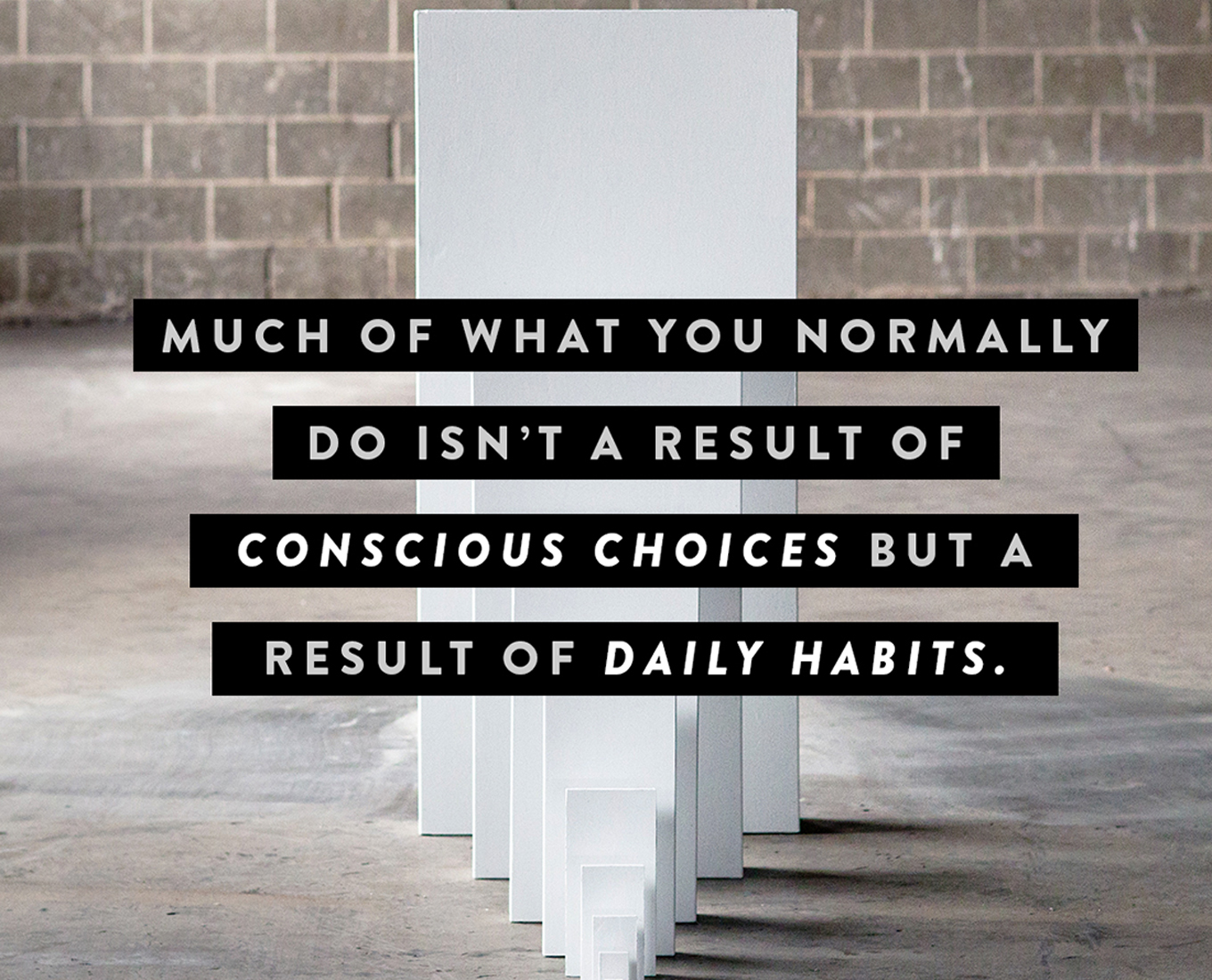
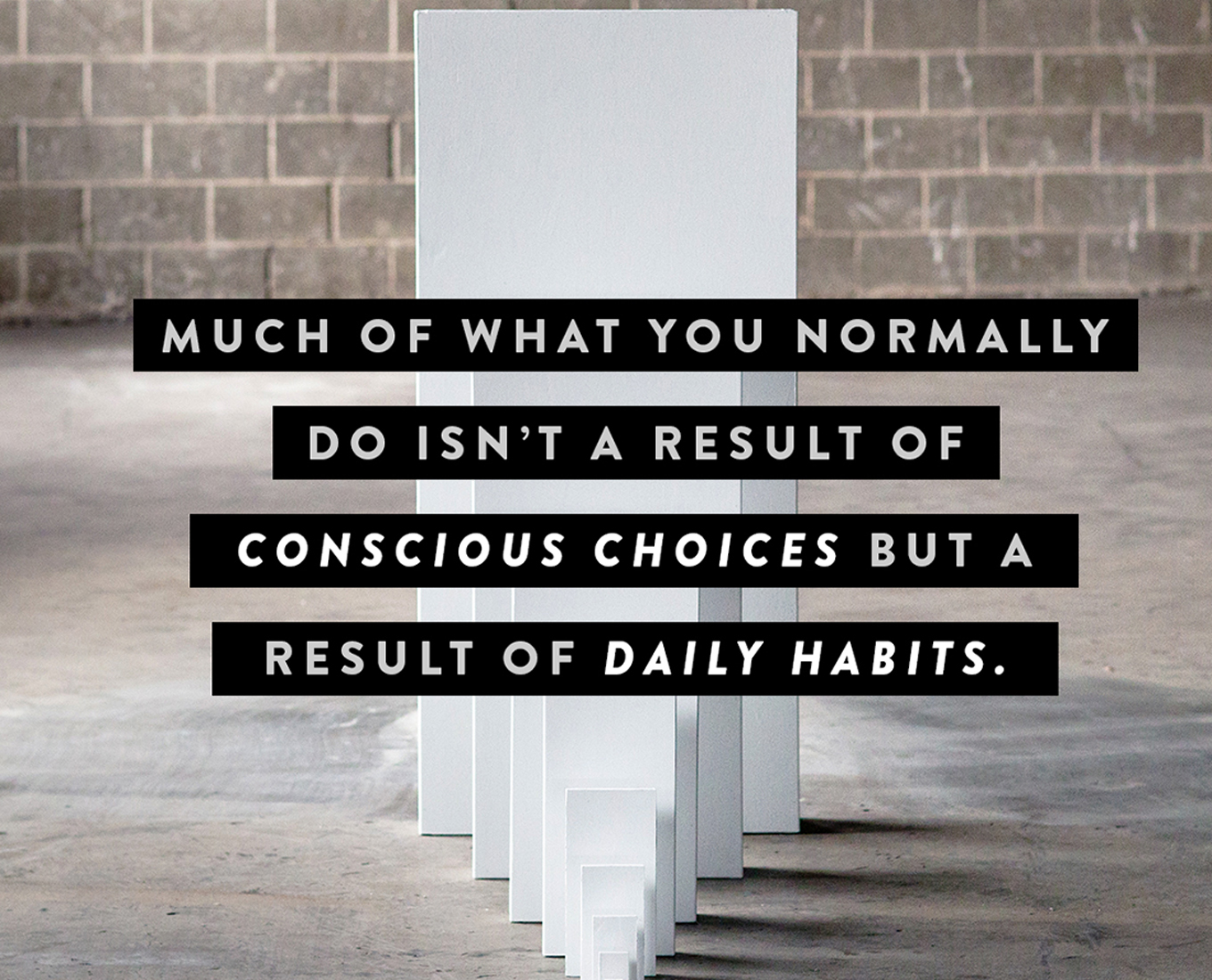
    Take a moment to conduct a mental audit of your last typical day. From the instant your alarm blared, your day unfolded as a sequence of deeply ingrained patterns. The way you silenced the alarm, the foot that first hit the floor, the path you took to the bathroom, your coffee-making ritual, and the familiar commute to work—all these actions likely occurred on autopilot, without requiring much, if any, conscious thought. This is the hidden force that shapes our existence: habit. Our lives are not so much a product of grand, decisive moments as they are the sum of our small, repeated behaviors. A landmark study from Duke University brought this into sharp focus, revealing that a staggering 40% of our daily actions are not the result of active decisions but are driven by habit.

    The Foundation of Our Lives: Habits and Systems

    The majority of what we do each day is not a result of conscious decision-making, but rather a reflection of our established habits. These habits, whether positive or negative, form the systems that govern our lives and ultimately determine our results. While we may set ambitious goals, we often fall short because we fail to develop the consistent, daily systems needed to achieve them. This is why a person can have the goal of being healthy, yet their habits of a poor diet and lack of exercise lead to an unhealthy lifestyle. It’s not the goal that’s the problem; it’s the absence of an effective system. The real power of change lies not in aiming for a specific outcome, but in building the right habits that will inevitably lead to that outcome.

    A perfect example of this is the story of Daniel. His remarkable success and exceptional character were not the result of a single heroic act, but of a consistent, lifelong habit. His enemies, unable to find fault in his public conduct, recognized that his strength came from his devotion to God. This devotion was a deeply ingrained habit—praying three times a day, every day. This one “keystone habit” served as the anchor for his entire life, influencing all his other decisions and behaviors. It was this faithful routine that gave him the strength to stand firm when faced with the threat of the lion’s den. Daniel’s life teaches us that a small act of obedience, performed consistently over time, can have a profound and lasting impact.


    How to Build a Better You

    Building a new habit requires a clear strategy. The key is to make the new behavior as easy and obvious as possible. By reducing the friction to perform the desired action, you increase the likelihood that you’ll stick with it. Instead of relying on motivation or willpower, you can design your environment to support your goals. For instance, if you want to eat healthier, place a bowl of fruit on your counter where you can see it and grab it easily. The goal is to create a cue that triggers the desired action automatically, without needing to think about it.

    This process can be structured using a simple formula: “I will [new habit] after I [current habit].” This links your desired new behavior to an existing routine, making it easier to remember and implement. For example, “I will read one page of a book after I brush my teeth” or “I will do five push-ups after I make my morning coffee.” By starting small, you build momentum and a sense of accomplishment. This small success reinforces a new identity—the person who does the things you want to do.

    This brings us to the most crucial element of habit formation: identity. Our habits are a reflection of who we believe we are. An unhealthy identity creates unwise habits, and those habits, in turn, reinforce the unhealthy identity in a vicious cycle. The solution is to focus on who you want to become, not just what you want to achieve. Do you want to be a patient parent? A financially responsible person? A disciplined child of God? When you define your desired identity, your actions begin to align with that person. Instead of saying, “I’m trying to quit smoking,” you can say, “I am a non-smoker.” This simple shift changes the narrative from one of struggle to one of conviction.


    The Long Game: Consistency and Tipping Points

    Change rarely happens overnight. Our lives are the sum total of all the small decisions we make along the way. While a single good or bad decision may seem insignificant, their cumulative effect over time is massive. Small, consistent actions are like adding drops of water to a pot on the stove. You may not see a change at first, but the temperature is steadily rising. At a certain point, a “tipping point” is reached, and the water begins to boil. At that moment, the results become undeniable, and people may call you an “overnight success.” They don’t see the years of private sacrifice, the early mornings, the difficult conversations, or the moments of self-doubt. They only see the harvest.

    The key is to not grow weary in doing good. Your small acts of faithfulness are not wasted; they are being stored up. As a Christian, your ultimate goal should be to become more like Christ. This isn’t a goal to be achieved in the future; it’s a daily act of obedience. Success is found not in some distant result, but in being faithful to God in the small things today. When you find joy in simply doing what He has called you to do, you are already successful. By focusing on becoming a better version of yourself, one small habit at a time, you build a life that honors God and reflects His character.

  • The Danger With “Your Truth”

    The Danger With “Your Truth”

    The Danger With Your Truth

    The Danger With Your Truth

    In a world filled with endless perspectives and competing ideas, one phrase has become a cultural cornerstone: “speak your truth.” It’s a powerful, liberating idea that suggests our individual experiences and feelings are the ultimate arbiters of what is real and valid. It’s an easy concept to embrace, promising authenticity and personal power. But what if “your truth” is not actually the truth at all? What if, instead of setting you free, it’s a trap?

    Talk it Over

    The Deceptive Lure of Self

    We live in a culture that champions the self. From the moment we wake up, we’re told to prioritize our needs, honor our feelings, and pursue our own happiness above all else. The message is pervasive: you deserve “me time,” your needs come first, and you should cut anyone out of your life who doesn’t add value to it. This “self-first” philosophy is so deeply ingrained that it feels natural and true. After all, isn’t it true that we look at ourselves first in every group photo? Don’t we instinctively determine the quality of that photo based on how we look? Putting ourselves first is one of the most natural human instincts.

    Yet, this natural instinct is constantly at odds with a higher calling. While society urges us to prioritize ourselves, many spiritual traditions and teachings propose a radical alternative. They suggest that our lives should be defined not by what we get, but by what we give; not by what we accomplish, but by how we love. The “self-first” mindset, while comforting and familiar, is a dangerous deception. It is “almost true” in its appeal, but ultimately, it’s a lie that leads to a life of isolation, anxiety, and a profound lack of fulfillment.

    The Paradox of Self-Obsession

    It’s a modern paradox: we are a generation obsessed with self-care, self-love, and personal fulfillment, yet we are more anxious, stressed, and depressed than ever before. If putting ourselves first is the key to happiness, why are we so miserable?

    The answer is both simple and confronting: perhaps our problem isn’t that we don’t love ourselves enough, but that we love ourselves too much.

    The “self-centered” view of life, and even of faith, suggests that a divine being exists to serve our needs. We believe we love this higher power, but in reality, we often love what we can get from it. When things don’t go our way, when a prayer isn’t answered in the way we want, our faith is shaken because we’ve built it on a foundation of self-interest rather than a genuine, selfless relationship.

    A core principle found in timeless spiritual wisdom is the call to love God and to love others. The teachings of Jesus make this clear. When asked about the greatest command, he didn’t say, “Love yourself.” He said to love God with all your heart, soul, and mind, and to “love your neighbor as yourself.” The crucial distinction here is that Jesus did not command us to love ourselves because he assumed we already do. He recognized that self-love is an innate human drive. We don’t need a command to put ourselves first; it’s what we do naturally. The challenge, then, is not to learn to love ourselves, but to redirect that powerful, innate love outward, toward God and others.

    The Call to Self-Denial

    In a culture that tells us to “pamper yourself” and “put yourself first,” the teachings of self-denial are particularly jarring. Jesus’ words to his disciples were shocking even in their own time. When he said, “Whoever wants to be my disciple must deny themselves and take up their cross and follow me,” his followers understood exactly what he meant.

    In the Roman-occupied world, taking up one’s cross was a public act of humiliation and execution. It meant dying to oneself completely. It was a clear and brutal metaphor. Jesus was not suggesting a small sacrifice; he was calling for a total surrender of the self. This call to deny ourselves is the ultimate antidote to the self-obsessed culture we live in. It is a radical departure from the idea that our lives are all about our own wants, desires, and dreams.

    The path to a fulfilled life is not found in prioritizing our own schedule, guarding our “me time,” or cutting people out who don’t add value. In fact, some of the most profound moments in life and faith are interruptions to our well-laid plans. It is in slowing down, being present with others, and allowing our schedules to be disrupted that we find the deepest purpose and love. The most important thing we do is not what we accomplish, but how we love.

    This is not a call to ignore our needs. It doesn’t mean we shouldn’t take a nap or enjoy a sweet treat. But it does challenge the motive behind our actions. If the sole purpose of self-care is for ourselves, it remains a selfish act. But if the purpose of self-care is to be healthy—mentally, emotionally, and spiritually—so that we can better love God and serve others, then it is a selfless act.

    The Unshakeable Reality of Grace

    The “self-first” mentality often leads to a “self-centered” version of spirituality, where we pick and choose what we believe based on what’s comfortable. This is a faith of convenience that seeks to add a higher power to our lives without subtracting our own selfish nature. But a true, authentic faith is one of total surrender. It is a daily decision to die to our selfish desires and offer our lives as a “living sacrifice.”

    This is not a journey to be embarked upon through willpower alone. Our own self-love is a powerful force that we cannot defeat on our own. It is an internal battle that requires a supernatural intervention. This is why our faith is rooted in grace. We are not saved by our works or by our ability to be good. We are saved by the perfect work of a higher power who, in an act of ultimate self-denial, gave everything for us.

    In view of that ultimate love and mercy, we are called to give our lives in return. It’s a profound exchange: a life of self-obsession for a life of purpose. It’s not about being perfect, but about being willing to deny ourselves and follow a higher path. This is a daily choice to surrender our own desires and live for a greater glory. It is a choice to step away from the lie of self-centeredness and into the truth that sets us free. This is a journey of true transformation, where we are made new from the inside out.

    A Reflection on Love

    The qualities of true love stand in stark contrast to the traits of a self-obsessed life. Love is patient and kind. It is not boastful or proud. It is not self-seeking or easily angered. These qualities are impossible to cultivate when we are consumed with our own needs and desires. Love cannot flourish in a self-centered environment.

    So, the question for reflection is this: In what area of your life are you loving yourself more than you are loving God and loving others? And what is the next step you need to

  • The Foundational Principle of Truth

    The Foundational Principle of Truth

    Chapter 14 of Realized Serenity
    The Foundational Principle of Truth

    The Foundational Principle of Truth

    The spiritual journey cannot begin on a foundation of lies. The first, most essential principle is Truth. In its simplest form, it is honesty—the ability to see things as they are, not as we wish they were. The inner discord we seek to heal thrives in the darkness of denial and self-deception. Therefore, our first act must be one of uncompromising self-honesty.

    A Story of Truth

    A man we’ll call Michael lived in a state of quiet desperation. His job paid well but drained his soul, and his evenings were spent numbing the feeling that his life was off track. To the world, he was successful. To himself, he was a fraud. The turning point came not in a dramatic moment, but in a quiet one. Sitting in his car during his lunch break, he finally allowed himself to whisper the words, “I am not happy.” It was a simple, terrifying truth. Speaking it didn’t magically solve his problems, but it broke the spell of denial. It was the first, honest step that allowed him to begin seeking a different way.

    The Antidote to Denial

    The principle of Truth is the direct antidote to the habit of denial. Denial is the refusal to see what is right in front of us, and it’s the force that keeps us stuck in painful situations. We deny our unhappiness in a relationship, our dissatisfaction in a career, or the reality of a health issue because the truth feels too overwhelming to face. This denial is a survival mechanism of the ego, the part of our mind designed to protect us from pain. It constructs a story that feels safer than reality. But this safety is an illusion; it is a cage that prevents growth and healing.

    By practicing rigorous honesty, we break the spell of denial and create the possibility for real, lasting change. This initial admission, like Michael’s, is the key that unlocks the door. But what lies on the other side? Acknowledging the truth is the first step, but the journey requires us to walk through the door into a deeper level of self-exploration.

    Beyond Denial: The Courage for Deeper Honesty

    Once we break through the first layer of denial, the journey of Truth asks for something more: Courage. Courage is not the absence of fear, but the willingness to act in spite of it. In this context, it is the courage to undertake a fearless and honest self-assessment. This is the daunting but essential task of looking honestly at our past actions, our limiting habits, and the deep-seated patterns that have caused suffering for ourselves and others.

    This deeper honesty requires us to look into what psychologist Carl Jung called the “shadow self”—the parts of ourselves we have repressed, denied, or deemed unacceptable. If we were taught that anger was bad, our anger went into the shadow. If we learned that vulnerability was weak, our vulnerability was hidden away. True honesty means having the courage to meet these exiled parts of ourselves, understanding that they hold immense energy and information. It’s about taking responsibility for our role in our own unhappiness, which is the ultimate act of empowerment.

    The Three Lenses of Insight

    A courageous self-assessment can be structured by looking through three specific lenses:

    1. Resentments: We look at who and what we are angry at. But we go deeper than blame. We ask, “What part of me felt threatened? What expectation was not met?” And most importantly, “What was my part in this situation?” This shifts us from the powerless position of a victim to an empowered agent in our own life.
    2. Fears: We list our deepest fears—fear of failure, fear of abandonment, fear of not being good enough. We then honestly trace how these fears have driven our decisions and behaviors. We see how fear has been the secret author of many of our life’s chapters.
    3. Harms Caused: This is perhaps the most difficult lens. We look at where our actions, driven by our resentments and fears, have caused harm to others. This is not an exercise in shame, but in responsibility. It is the clear-eyed acknowledgment that our unhealed wounds often wound others.

    Undertaking this kind of inventory is not about self-flagellation. It is an act of profound self-compassion. It is saying, “I am willing to see the whole truth of myself, so that I can be free.”

    From Honesty to Wholeness: Living with Integrity

    This path of radical truth-telling naturally leads to the principle of Integrity. Integrity is the state of being whole and undivided. It is the practice of becoming authentic and real, where our outer life begins to accurately reflect our inner values. When we live with integrity, the painful gap between who we want to be and who we actually are begins to close.

    Living with integrity means our “yes” is a true yes and our “no” is a true no. It means setting boundaries not as walls to keep people out, but as kind and clear lines that teach people how to treat us. A boundary is a statement of truth: “This is what I need to protect my peace.” When we fail to set boundaries, we betray our own truth, which inevitably leads to resentment.

    The journey begins with the simple truth (“I am not happy”). It gains momentum with the courageous truth (“Here are the patterns and habits that contribute to my unhappiness”). It finds its expression in the lived truth of integrity (“I will now make choices that align with my well-being and values”). This is how we stop betraying ourselves. The peace that comes from this alignment is far more satisfying and sustainable than any temporary comfort gained from denial or pretense. Truth, then, isn’t just about admitting a painful reality; it’s the foundational act of building a life that is genuinely, authentically, and joyfully our own.

    Putting it into Practice: The Threefold Honesty

    • Honesty with Ourselves: This is the silent, courageous admission in the quiet of our own hearts: “This is not working. I am in pain. I need help.”
    • Honesty with Another Person: Shame cannot survive being spoken. Find one trusted person and share one small piece of your truth. The act of speaking it out loud and having it met with acceptance is profoundly healing.
    • Honesty with a Higher Power: This is the act of surrendering the ego’s pride through a simple prayer or intention: “I can’t do this alone. I am willing to see this differently. Please help me.”

    This Week’s Practice

    Identify one small area in your life where you have been less than 100% honest with yourself. It could be about your health, a relationship, or your finances. Write the simple, unvarnished truth about it in your journal. You don’t have to fix it yet. Just let it be true.

    Going Deeper

    • What “truth” are you mos
  • The Transformative Principle of Hope

    The Transformative Principle of Hope

    Chapter 15 of Realized Serenity
    The Transformative Principle of Hope

    The Transformative Principle of Hope

    After the stark, clarifying light of Truth reveals the reality of our situation, the spiritual journey requires a second, equally vital principle: Hope. Hope is not a flimsy wish or a passive form of escapism. It is the profound recognition that a different way of life is possible. It is the active belief in a power and a potential greater than our own past suffering. After honesty has cleared the ground, hope is the first seed we plant. This glimmer of hope leads to a pivotal realization: it will take something more powerful than our own exhausted ego to heal.

    A Story of Hope

    Sarah felt trapped in a cycle of anxiety that had plagued her for years. She had tried everything she could think of, but nothing seemed to provide lasting relief. She had concluded that this was just “who she was.” Her hope was reignited in a support group, not by a grand promise, but by listening to an older woman describe a similar struggle. The woman spoke of her own past anxiety with a calm acceptance and shared how, through small, daily practices, her life had slowly transformed. Sarah saw in this woman not a perfect, cured person, but a fellow traveler who was a few steps further down the road. For the first time, she dared to believe that if it was possible for someone else, it might just be possible for her, too.

    The Antidote to Despair

    Hope is the direct antidote to the state of despair. Despair is not merely sadness; it is a rigid, frozen belief that tomorrow will be just as painful as today. It is the ego’s declaration that the past is a perfect predictor of the future. When we are in a state of despair, our minds become echo chambers of our own limitations, replaying our failures and reinforcing the story that we are uniquely broken or stuck. This creates a prison of hopelessness, where the walls are built from our own limiting beliefs.

    The practice of Hope is the active, daily work of challenging that story. It is the willingness to look for evidence, however small, that a new reality is taking shape. It doesn’t deny the reality of present pain, but it refuses to grant that pain a monopoly on the future. Hope introduces the radical idea of “possibility” into a closed system of certainty. It is the force that thaws the frozen landscape of despair, allowing for movement and new growth.

    Beyond Wishing: The Active Cultivation of Hope

    Hope is not a passive state we wait for; it is an active discipline we cultivate. It requires us to consciously shift our focus and engage in practices that build a case for a better future. This cultivation can be understood as a three-part process: borrowing belief when we have none, gathering evidence to support that belief, and connecting to a source of strength larger than ourselves.

    Borrowing Belief: The Power of Community

    When our own well of hope has run dry, the first step is to borrow it from others. This is the profound power of community, as Sarah discovered. Despair thrives in isolation, telling us the lie that we are the only one who feels this way. When we hear the stories of others who have walked through similar darkness and found their way to the light, that lie is shattered.

    A story of recovery or transformation is not just a story; it is a piece of living evidence. It provides a tangible roadmap and a powerful reminder that our current state is not a permanent destination. By listening with an open heart, we can borrow the belief of those who have gone before us. We can stand on the foundation of their hope until we are ready to build our own. This is why sharing our truth in safe, supportive communities is a cornerstone of this path.

    Gathering Evidence: Training the Mind to See the Good

    Our brains are wired with a “negativity bias,” a remnant of our evolutionary past where scanning for threats was essential for survival. In the modern world, this often means our minds are like Velcro for negative experiences and Teflon for positive ones. If left untended, the mind will naturally build a stronger case for despair than for hope.

    The practice of “gathering evidence” is a conscious intervention in this process. By deliberately keeping a “Hope Log” or a gratitude journal, we are retraining our minds to scan for the good. At the end of each day, writing down one to three specific things that brought a moment of peace, connection, or beauty is not a trivial exercise. It is the act of gathering data that contradicts the ego’s story of despair.

    Did a stranger smile at you? Did the sun feel warm on your skin for a moment? Did you handle a difficult moment with a little more grace than you would have in the past? Each of these is a point of light. By recording them, you are building a constellation of hope, proving to yourself, one day at a time, that goodness, beauty, and progress are real and present in your life.

    Defining a Source of Hope: Connecting to Something Larger

    Perhaps the most powerful practice for cultivating hope is to connect with a power greater than our own isolated, fearful ego. For many, the ego is the source of the problem—it is the part of us that is exhausted, limited, and trapped in repetitive patterns. To believe that this same ego can solve the problem is a recipe for continued frustration. Hope blossoms when we source our strength from something larger.

    This “Higher Power” does not need to be a traditional religious concept. The goal is to find a connection to a source of strength, wisdom, and love that feels authentic to you. Consider these models:

    • Nature: The profound intelligence that grows a forest, spins the planets, and heals a wound. Connecting with nature reminds us that we are part of a resilient, cyclical, and wise system that is constantly moving toward life.
    • Universal Consciousness: The idea that we are all waves in a single ocean of awareness. This connects us to a collective intelligence and creativity far greater than our individual mind.
    • Unconditional Love: The belief that the fundamental energy of the universe is a benevolent, supportive force. By aligning with this force through acts of compassion and forgiveness, we tap into an infinite source of strength.
    • Your Deepest Self (The Observer): The silent, calm, and wise awareness within you that is deeper than the chattering ego. This is the discovery that the power you are seeking is not external, but is the very essence of your own being.

    By defining and consciously connecting with a source of hope greater than your “small self,” you are no longer alone in your struggle. You have a wellspring of support to draw from, which makes the journey not only possible, but sustainable.

    Putting it into Practice: The Threefold Path to Hope

    • Borrow Belief: When you cannot find it within yourself, borrow it from others. This is the power of community. Listen to the stories of those who have found their way through the darkness.

  • The Liberating Principle of Surrender

    The Liberating Principle of Surrender

    Chapter 16 of Realized Serenity
    The Liberating Principle of Surrender

    The Liberating Principle of Surrender

    After we have faced the truth and opened ourselves to hope, we arrive at one of the most challenging and paradoxical principles on the spiritual path: Surrender. In a world that tells us to hustle harder, take control, and never give up, the idea of surrender can feel like failure. We mistake it for passive resignation, weakness, or simply letting life walk all over us. But true spiritual surrender is the opposite. It is a conscious, courageous, and profoundly empowering act. It is the release from the “illusion of control” and the wisdom to accept the things we cannot change so we can focus our precious energy on the things we can.

    A Story of Surrender

    David was a worrier. He worried about his children, his job, and his health. His mind was a constant buzz of “what if” scenarios, and he believed his vigilance was what kept disaster at bay. The exhaustion became unbearable. One day, stuck in traffic and spiraling about being late, he tried something new. He took a deep breath and said out loud, “I can’t control this traffic. I will get there when I get there.” He expected to feel anxious, but instead, a wave of relief washed over him. He realized his worry wasn’t controlling the traffic; it was only controlling him. This small moment of surrender was the beginning of learning to release what was never his to hold.

    The Antidote to the Habit of Control

    Surrender is the direct antidote to the ego’s addiction to control. This addiction manifests in our lives as chronic worry, micromanagement of people and situations, and the relentless attempt to fix things that are not ours to fix. The ego believes that if it can just plan enough, anticipate enough, and worry enough, it can bend reality to its will and keep us safe from pain and uncertainty.

    This habit of control is the source of immense suffering. It fuels our anxiety, creating a constant state of low-grade (or high-grade) stress as we battle against the natural, unpredictable flow of life. It damages our relationships as we try to control the behavior and feelings of others. And it leads to burnout and exhaustion, as we deplete our vital energy trying to manage a universe that is fundamentally unmanageable. The practice of Surrender is the process of learning to shift our trust from our own limited, fear-based strategies to a deeper faith in life itself.

    The Great Illusion: Believing We Are in Charge

    David’s story in the traffic jam is a perfect metaphor for our lives. We are constantly trying to mentally control things that are utterly beyond our influence: the economy, the weather, the opinions of others, the aging of our bodies, the timing of events. Worry is the mechanism we use. We believe that by worrying, we are somehow doing something productive. We are “on the case.” But worry is a mental rehearsal for a catastrophe that usually never happens. It is a transaction with the future that drains the present of its vitality, offering nothing in return.

    The profound liberation of surrender comes when we finally see this illusion for what it is. We realize that our control is, and always has been, limited to a very small circle. The vast majority of life unfolds according to laws and forces far beyond our personal command. Accepting this is not a sign of weakness; it is a sign of wisdom. It is the end of arguing with reality. When we stop fighting the river, we are free to learn how to navigate its currents.

    The Wisdom of Acceptance

    It is crucial to distinguish surrender from apathy or passivity. Surrender is not about giving up on our goals or refusing to take action. It is about accepting the reality of the present moment as our starting point. When we are in a state of resistance, we are blinded by our frustration. We cannot see our options clearly because all our energy is consumed by wishing things were different.

    Acceptance, which is the heart of surrender, allows us to see the situation with clarity. “Okay, this is what is happening. The flight is canceled. The diagnosis has been given. The relationship has ended. Now, given this reality, what is my next right action?” Surrender allows us to move from the reactive, emotional brain into the wise, responsive mind. We stop wasting energy on the “what if” and “should have been” and redirect that energy toward “what is” and “what now.” This is where our true power lies.

    Embodying Surrender: From Mind to Body

    The habit of control is not just a mental pattern; it is a physical one. A mind that is constantly trying to control the world lives in a body that is chronically tense. Clenched jaws, tight shoulders, and a constricted stomach are the physical signatures of a life lived in resistance. We are literally holding on for dear life.

    This is why practices that engage the body are so essential for learning to surrender. We cannot simply think our way into letting go; we must feel our way into it. The Body Scan Meditation is a profound training in the art of surrender. As you systematically move your awareness through your body, you are not forcing relaxation. You are simply bringing your attention to a tense muscle and, with the out-breath, giving it permission to release. You are practicing the physical act of letting go, one small part at a time. You are teaching your nervous system, on a cellular level, that it is safe to release its grip.

    Putting it into Practice: The Art of Letting Go

    • Identify Your Circles of Control: List your current worries and place each one in the appropriate circle: What I Control, What I Can Influence, or What I Cannot Control. Your work is to take action on the inner circle and practice surrender on everything else.
    • Embody Surrender: Use the Body Scan Meditation from the appendix. As you scan each part of your body, you are practicing the physical act of releasing control.
    • Use a Mantra: When you are caught in a loop of worry, use a simple phrase to interrupt the pattern. A powerful one is, “I can handle this moment. The rest is not my job.”

    This Week’s Practice

    Identify one thing this week that is completely outside of your control. It could be the weather, another person’s mood, or a global event. Every time you find yourself worrying about it, consciously practice saying to yourself, “This is not mine to control,” and gently redirect your attention to your breath.

    Going Deeper

    • What is the “worst-case scenario” you are trying to prevent with your worry and control?
    • What would your life feel like if you had a deep, abiding trust that things would work out for the best, even if it’s not according to your plan?

    An Affirmation for the Path

    “I release my need to control and trust the flow of life.”

    </b